



Davina McCall Changed the HRT Conversation. But Is HRT the Only Answer to Menopause?

Few people have changed the public conversation around menopause in Britain quite like Davina McCall.
For years, menopause was something women were largely expected to get on with quietly. Hot flushes were joked about. Brain fog was dismissed. Anxiety was often treated without anyone asking whether hormones might be involved. Women reached their forties and fifties experiencing profound physical and emotional changes without necessarily understanding what was happening to them.
Then menopause became a national conversation.
Davina McCall played a significant part in making that happen. By speaking publicly about her own menopause and becoming a prominent advocate for hormone replacement therapy (HRT), she helped push a subject that had spent decades behind closed doors into television programmes, newspapers, workplaces and GP surgeries.
That deserves recognition.
But the conversation has evolved again.
Spend enough time in menopause communities today and you'll find women asking a slightly different question. Not simply "Should I take HRT?", but "What if I don't want to?"
What if you're uncomfortable with hormone therapy? What if you've tried it and didn't like how you felt? What if your medical circumstances make the decision more complicated? What if your symptoms are manageable enough that you'd rather begin with lifestyle changes and non-hormonal support? Or what if you simply want to understand all your options before deciding?
At Feminapause, we believe the next stage of the menopause conversation should be about exactly that.
Choice.
Because empowering women to talk about HRT was progress.
Making women feel as though HRT is the only credible way to navigate menopause would not be.
First, Let's Be Fair About HRT
There is no credible version of this conversation in which we pretend HRT doesn't work.
It does.
Hormone replacement therapy replaces some of the hormones that decline around menopause, principally oestrogen, with a progestogen also required for most women who still have a uterus.
For vasomotor symptoms such as hot flushes and night sweats, HRT is an established and effective treatment. Current NICE guidance recommends offering HRT to people experiencing menopause-associated vasomotor symptoms.
It can also be particularly valuable for vaginal and genitourinary symptoms, and HRT helps prevent the loss of bone density associated with falling oestrogen.
The old narrative that HRT is universally dangerous is not supported by current evidence either. Modern guidance takes a much more individualised view of benefits and risks, considering factors including age, medical history, type of HRT, whether it is taken orally or through the skin and whether oestrogen is used alone or alongside a progestogen.
So this isn't an article telling women they should be frightened of HRT.
Quite the opposite.
Women deserve accurate information about it.
But they deserve accurate information about the alternatives too.
The Problem Begins When "An Option" Starts Sounding Like "The Answer"
There has been an extraordinary correction in the public menopause conversation over the last decade.
For years, many women who could potentially have benefited from HRT were frightened away from it.
Today, the pendulum has moved significantly.
HRT is discussed openly. Women understand it better. Celebrities talk about it. Menopause specialists discuss it on social media. Workplaces run menopause programmes. Women arrive at medical appointments already knowing the words oestrogen, progesterone and testosterone.
Much of that is positive.
But somewhere along the way, another message can inadvertently emerge:
If you're struggling with menopause, you need to replace your hormones.
That's where we think the conversation needs more nuance.
Menopause is not a disease caused by a medication deficiency.
It's a biological transition.
For some women, replacing hormones dramatically improves their quality of life. For others, the decision isn't nearly so straightforward.
And crucially, not every woman wants the same thing from menopause treatment.
One woman may have debilitating night sweats that are destroying her sleep and happily choose HRT.
Another may have manageable anxiety, fatigue and mood changes and prefer to begin with lifestyle and non-hormonal support.
Another may have a complicated medical history requiring specialist advice.
Another may try HRT and decide it isn't for her.
All four deserve to feel that they're making legitimate decisions about their own bodies.
What Does the Evidence Actually Say About Choice?
Interestingly, current clinical guidance is considerably more nuanced than social-media debates sometimes suggest.
NICE recommends discussing the benefits and risks associated with each potential management option and tailoring those conversations to the individual's circumstances and risk factors.
Menopause-specific cognitive behavioural therapy, for example, can be considered for vasomotor symptoms either alongside HRT, when HRT is contraindicated or when someone simply prefers not to take HRT.
The British Menopause Society similarly provides dedicated evidence-based guidance on non-hormonal treatments and acknowledges that clinicians need to understand alternatives so they can properly inform women about their options.
That matters.
Because "I don't want HRT" shouldn't end the menopause conversation.
It should begin a different one.
What Does a Non-Hormonal Approach Actually Look Like?
This is where the word "natural" needs some unpacking.
A natural approach shouldn't mean throwing away evidence, ignoring medical advice and buying whichever herbal remedy has the prettiest packaging.
Nor should it mean simply tolerating symptoms because menopause is "natural".
Menopause is natural.
So is tooth decay.
Natural doesn't automatically mean something should be endured without support.
A sensible non-hormonal menopause strategy starts by looking at the whole woman rather than attempting to replace one hormone and expecting every other problem to disappear.
How are you sleeping? Are you maintaining muscle? Are you physically active? Are you eating enough protein? Are you getting adequate vitamin D and calcium? Are nutritional deficiencies contributing to fatigue? How much alcohol are you drinking? How stressed are you? Are anxiety and poor sleep feeding into one another? Are you socially connected? Are you actually giving your body what it needs during a period of enormous physiological change?
These questions aren't as headline-friendly as "HRT: yes or no?"
But they matter enormously.
Menopause Support Doesn't Have to Begin With a Prescription
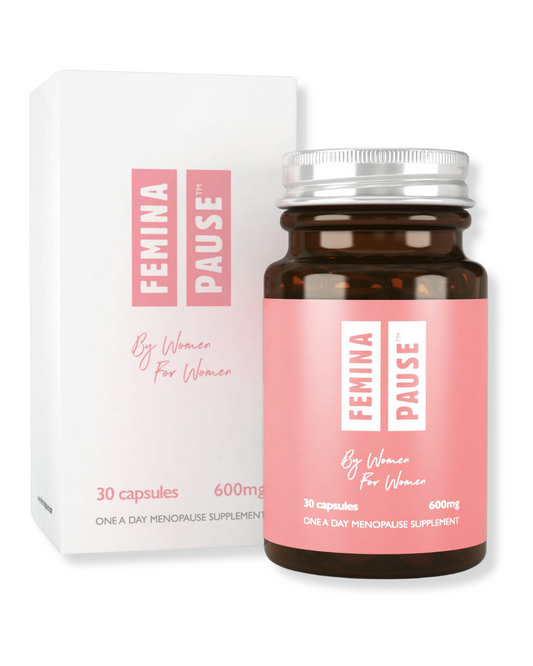
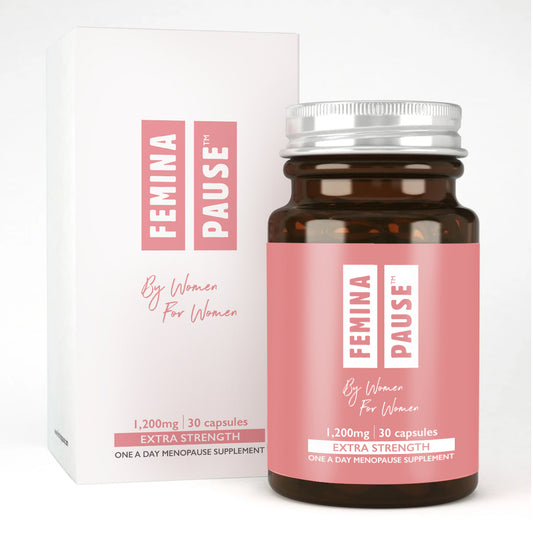
This is one of the principles behind Feminapause.
We believe women should be able to support their bodies before symptoms become unbearable.
That means building strong foundations through nutrition, exercise, sleep and stress management, but it can also mean choosing targeted, non-hormonal supplementation.
Feminapause was created specifically for women looking for another route.
Our once-daily formulation combines full-spectrum CBD, vitamin B6, vitamin B12 and MCT oil rather than attempting to recreate declining reproductive hormones.
B6 and B12 contribute to normal energy-yielding metabolism, normal nervous-system function, normal psychological function and the reduction of tiredness and fatigue. Vitamin B6 additionally contributes to the regulation of hormonal activity.
That makes them particularly relevant nutrients during a stage of life when many women tell us that energy, resilience and feeling like themselves have become harder to maintain.
The CBD component gives Feminapause its distinctive non-hormonal foundation, while MCT oil acts as the carrier.
Is Feminapause HRT in a natural capsule?
Absolutely not.
And we don't think it should pretend to be.
It's a different approach entirely.
For women who don't want to replace hormones, who aren't ready to explore HRT, or who simply want to begin by supporting their bodies through a non-hormonal route, Feminapause offers an alternative designed specifically with that woman in mind.
What HRT Can Do—and What It Can't
Another reason the debate becomes distorted is that menopause symptoms are frequently treated as though they're entirely hormonal.
Hormones matter enormously.
But a 52-year-old woman's health is not simply the sum of her oestrogen level.
If she's sleeping five hours a night, HRT may help if hot flushes are waking her — but it cannot manufacture a healthy sleep routine.
If she's losing muscle because she hasn't performed resistance exercise in fifteen years, HRT isn't a replacement for strength training.
If she's deficient in B12 or iron, replacing oestrogen doesn't correct that deficiency.
If she's chronically stressed, isolated, drinking heavily or eating poorly, those factors still matter.
And if she has spent decades putting everybody else's health ahead of her own, menopause sometimes becomes the moment when the consequences of that neglect become impossible to ignore.
Perhaps that's why the most productive menopause conversation isn't:
"HRT or natural?"
It's:
"What does this particular woman actually need?"
The Natural Menopause Industry Needs to Earn Women's Trust Too
We should also challenge our own side of the industry.
The word "natural" has become an extraordinarily effective marketing tool.
But plants can have pharmacological effects. Supplements can interact with medication. Ingredient quality varies. More isn't necessarily better, and a product containing fifteen botanicals isn't automatically more sophisticated than one containing four carefully selected ingredients.
NICE specifically advises women that the efficacy and safety of unregulated hormone preparations are unknown and highlights uncertainty around the safety and potency of some complementary products.
So if we're going to argue that women deserve credible alternatives to HRT, those alternatives need to deserve credibility.
At Feminapause, we'd rather tell you exactly what an ingredient is doing than hide behind vague promises of "hormone balance".
We'd rather use a focused formulation than create an enormous ingredient list purely for marketing.
And we'd rather be part of a menopause conversation in which women understand their options than one in which they're pressured into choosing a side.
Perhaps Davina's Biggest Contribution Wasn't HRT After All
Maybe the most important thing Davina McCall helped achieve wasn't convincing women to take hormone replacement therapy.
Perhaps it was convincing women that menopause deserved to be talked about at all.
That women didn't have to silently tolerate debilitating symptoms.
That asking for help wasn't weakness.
That something affecting half the population shouldn't remain a whispered conversation.
If that's the legacy, then the next step feels obvious.
The conversation should become broader, not narrower.
Women who choose HRT deserve support.
Women who cannot take it deserve support.
Women who aren't sure yet deserve time and good information.
And women who want to explore lifestyle changes and non-hormonal menopause support deserve better than being told that their choices are somehow less legitimate.
So, Is HRT the Best Way Through Menopause?
For some women, it may be the most effective treatment for the symptoms that are affecting them most.
For others, it won't be their first choice.
There is no contradiction in acknowledging both.
HRT has an important place in modern menopause medicine. The evidence supporting its use for certain symptoms is substantial, and women who want it should be able to have informed conversations about accessing it.
But menopause care is bigger than HRT.
It includes movement, muscle, sleep, nutrition, psychological wellbeing, relationships, bone health, cardiovascular health and, where women want it, thoughtfully chosen non-hormonal support.
Feminapause exists for women who want that alternative path.
Not because we believe women should be frightened of hormones.
Not because we believe one capsule replaces good medical care.
But because we believe women deserve more than one option.
And after years of fighting to give women a louder voice in menopause, surely the next evolution of that movement is allowing women to use that voice to say:
"I've looked at my options. This is the approach I want for me."